
The New Season of Bullhorns & Bullseyes Is Here. Let's Talk About the Trap You're Already In.
“How did you go bankrupt?” Bill asked.
“Two ways,” Mike said. “Gradually. And then suddenly.”
That’s Hemingway. The Sun Also Rises. And it’s the best description I’ve found for what’s happening to marketing budgets right now.
We’ve been quiet for four months. Not because Curtis and I ran out of opinions. Because we decided that if Season 3 were going to exist, it had to be something you could actually use. Not a collection of loosely connected conversations. A sequence. Eight episodes. Each one building on the last. Starting with this one. »
By the end, you’ll have something that works whether you listen once or come back to it in a year.
Think of Season 3 as an 16-week semester of higher education, with each episode serving both as a discrete learning module and as a sequential building block leading up to the final exam. There is a purposeful order to things this year. And we’re relying once again on some of the best and brightest minds in marketing and business development to help us advance the learning.
It starts with the uncomfortable part.
The wrong station, turned up loud. I used this analogy with Curtis during the episode and I want to share it here because I think it lands.
Imagine your marketing is a radio. And the radio is stuck on country music. But your customer hates country. AI comes along and says: just turn it up. Louder. More channels. More volume. And all your customer is thinking is, this is not for me. Their inclination isn’t to listen harder. It’s to change the station.
That’s the trap. Companies are spending more, producing more, deploying more. AI lets them do it all faster. And nobody is stopping to ask: are we even on the right station for the right listener?
Curtis put it bluntly in the episode. He said it’s like calling IT because your network is down, and instead of checking whether the cable is plugged in, they replace the $50,000 server.
He spent 15 years in IT before marketing, and the thing that drives him crazy is how quickly companies skip the simple diagnosis and jump straight to expensive solutions. You wouldn’t do that with a server. But companies do it with their marketing budget every single day.
Mirror, Mirror…
Here’s the part from the episode that I keep coming back to.
Mirror, mirror on the wall, who’s the fairest of them all?
You know the line. The queen asks the mirror. The mirror tells her exactly what she wants to hear. She’s pacified. Everything is fine. Until it isn’t. And when the truth finally shows up, she goes into a rage.
That’s what most marketing looks like.
Your homepage says “We are...” Your pitch deck leads with company history. Your AI tools polish that mirror until it gleams. And the mirror keeps telling you what you want to hear. You’re the fairest of them all. Your product is the best. Your differentiators are clear.
But the customer is not in the mirror. The customer is on the other side of the window. And most companies haven’t actually looked through that window in a very long time.
Curtis made a point that stopped me during our conversation. He said when you train AI without your customer’s reality, you’re just training it with the mirror. All it knows is your reflection. And a better reflection of yourself is not a reflection of your customer. Of course it’s going to tell you that you’re the fairest of them all.
But does the customer care about that? Not yet…
Nobody does this on purpose. It’s not vanity. It’s just the natural gravity of running a business. You know yourself. You talk about yourself. And gradually, then suddenly, you realize nobody’s listening.
The Chaos Tax
This is Curtis’s concept, and I’ll let him explain the math, because that’s what he does.
You know what you pay for a lead. You might know your close rate. But do you know what you pay for a lead that actually becomes revenue? Not a form fill. A customer.
The gap between those two numbers is what Curtis calls the Chaos Tax. It never shows up on a P&L. But it compounds. Every quarter you operate inside the trap, you’re not just wasting that quarter’s budget—you’re training your algorithms, your team, and your market to expect the wrong thing from you.
AI makes the slope steeper. Not because AI is bad. Because AI is indifferent. It amplifies whatever you give it. If the inputs are wrong, you just waste money faster. With better production value.
Going the wrong way. And making incredible time.
Four Gates
We laid down four principles in this episode. I’d call them sequence gates. You don’t get to skip ahead.
Coherence before creativity. This one’s mine, so I’ll own it. I love the creative side of this business. But I can’t write a tagline that works if I don’t coherently understand what I’m being creative about. A beautiful message built on the wrong insight is just a beautiful mistake.
Diagnosis before deployment. Curtis’s. He’s never going to let you spend money on ads before confirming your tracking works. Think of it like the IT help desk asking if you’ve rebooted. It’s annoying. It’s also the right first question. And, increasingly, he’s not going to let you deploy your campaigns until you’ve done the coherence work first.
Meaning before media. Talk to five customers. Find the truth. Find what actually matters to them. Then go spend money on commercials and marketing. Not the other way around.
Revenue before reach. Prove it converts before you scale it. The algorithms will find more people like the ones already buying. But only if you’ve done the work to know who those people are.
Your Homework (that I know you won’t do, but should!)
I’m giving you homework. I’m also betting exactly zero of you will do it. But here it is.
Go have actual conversations with five customers. Ask them four questions:
→ What was life like before you even heard of us?
→ What pain made you go looking?
→ Why did you choose us? You could have chosen anyone.
→ How is your life different now that you’ve been working with us?
If you do this, you’ll have the foundation for everything this season is going to teach you.
If you skip it because you “already know the answers,” well. That’s the mirror talking.
Two reasons people won’t do this:
One, they’re afraid a customer might say something they don’t want to hear.
Two, they’re convinced they already know what customers will say.
Both of those are the trap. Both of them cost you money every quarter you avoid them.
What’s on the Syllabus This Semester
We didn’t offer a single solution in this episode. On purpose. This is the diagnosis. The indictment.
Over the next eight episodes, Curtis and I are building the solution. The science behind why customers actually choose. How to excavate truth your customers won’t volunteer. How to turn that truth into a story that moves revenue. How to build a community that compounds. How to own your audience instead of renting it on platforms that can change the rules tomorrow.
By the end, you’ll have a system. Not theory. Something you can run.
But it starts here. With one honest question: When was the last time you actually talked to a customer? Not surveyed. Talked. And listened.
If the answer is more than 90 days ago, you’re marketing from memory. Not reality.
Watch or Listen to Season 3, Episode 1: THE TRAP
Available on YouTube, Apple Podcasts, Spotify, and everywhere you listen.
If this resonates, read the piece that started this whole arc: AI Isn’t Your Prophet. It Might Be Your Amplifier.
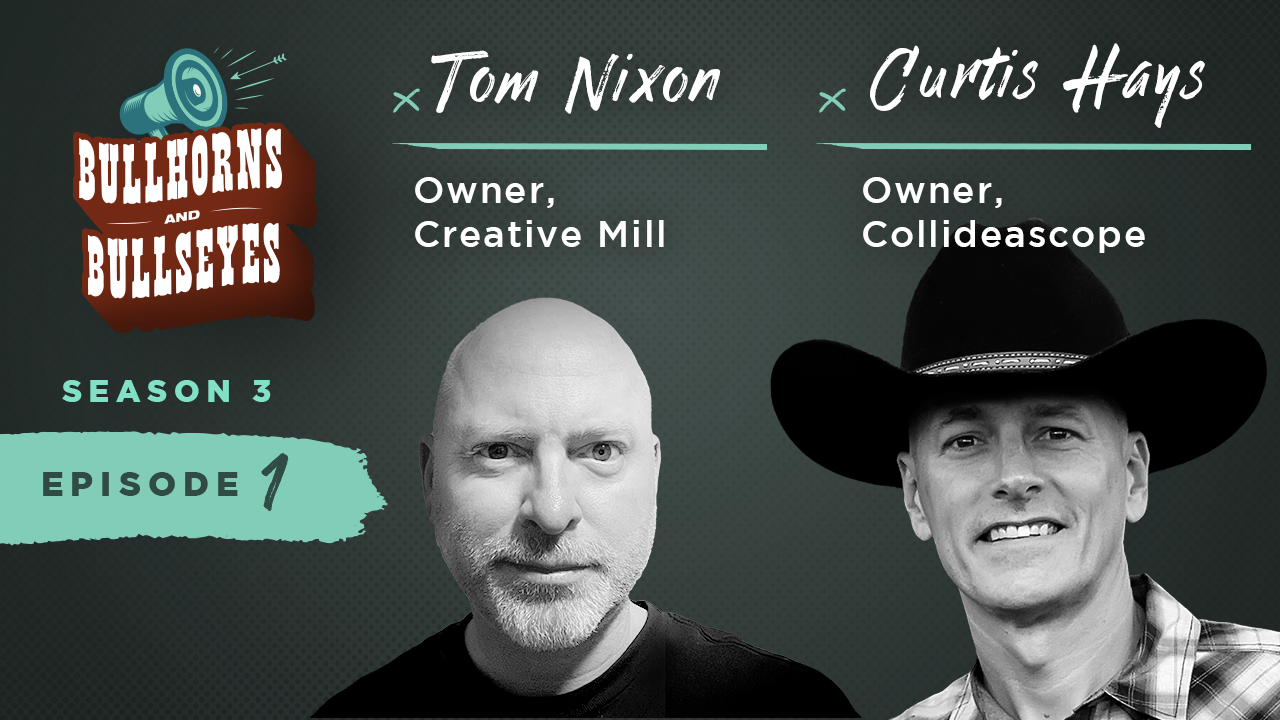
Bullhorns & Bullseyes is hosted by Curtis Hays and Tom Nixon. Season 3 drops a new episode every two weeks.